









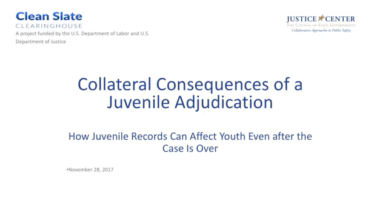
Collateral Consequences of a Juvenile Adjudication: How Juvenile Records Can Affect Youth Even After the Case Is Over
Hosted by the Clean Slate Clearinghouse, with funding support from the U.S. Department of Labor’s Employment and Training Administration and the U.S. Department of Justice’s Bureau of Justice Assistance
Juvenile records do not just disappear when youth turn 18, and those records can significantly affect a child’s employment, housing, and educational opportunities, leaving many young people with tremendous hurdles as they attempt to become successful adults. This webinar explores the breadth of collateral consequences of a juvenile adjudication and discusses ways in which youth can overcome some of those barriers. This webinar is particularly helpful for professionals who work with youth involved in the juvenile court system.
Find other events

You might also be interested in

The Judge Stephen S. Goss Memorial Award for Leadership has expanded to include Lifetime Achievement Awards and, in…
Read More
On October 9, 2025, the Senate passed the Second Chance Reauthorization Act of 2025 (S. 1843), which would…
Read More
The CSG Justice Center has partnered with the Pennsylvania Commission on Crime and Delinquency and CIT International to…
Read More 2025 Nominations Now Open for Judges and Psychiatrists Improving Lives and Behavioral Health
Read More
2025 Nominations Now Open for Judges and Psychiatrists Improving Lives and Behavioral Health
Read More

 CSG Justice Center Launches First-of-Its-Kind Statewide Crisis Intervention Teams (CIT) Technical Assistance Center
Read More
CSG Justice Center Launches First-of-Its-Kind Statewide Crisis Intervention Teams (CIT) Technical Assistance Center
Read More
 How Kentucky’s “Seth’s Law” Reduces Barriers to Care for Competency to Stand Trial and Guardianship
Read More
How Kentucky’s “Seth’s Law” Reduces Barriers to Care for Competency to Stand Trial and Guardianship
Read More